Wednesday, March 6, 2013

Federal Budget Chart Showing the Sequester Savings

.
Using data from the Congressional Budget Office, (Summary Table 1 and Table 1-7), anyone can easily create the following chart showing how the Sequester affects the Federal budget this year and for future years.

Federal Budget Chart Showing the Sequester Savings

Hmmm…. Somehow it doesn't look like a significant cut.

Why isn't this chart the lead story on every news site with the headline, "Sequester Has Nearly Zero Effect"?

One of the rules of politics is that when forced to make budget cuts, you should always cut the most vital things first -- thus punishing the populace and their representatives for even suggesting it.

Mr. O is very good at this; he was trained in Chicago by the best political machine the world has ever known. So he immediately stated that the "choices of Republicans in Congress" will force massive cuts in Social Security and Medicare, as well as police, education, and defense.

But of course there will be no cuts for the $250 million in payments to our "friends" in Egypt, or thousands of new uniforms for the TSA, or uncountable other areas of pure waste and cronyism.

Other Democrats echo the new party line that the Sequester shows the Republicans are "intent on dismantling the government of the United States". (See Robert Reich's blog, and around 60 separate Huffington Post pieces of propaganda articles.)

Ah, if only it were true.

But government spending in 2013 will still be more than 2012 even with the sequester, and is projected to grow out of control as far as we can see into the future.

The sequester "reduction" is absolutely meaningless.
.

Friday, December 28, 2012

Where are the Carriers Now? December 26, 2012 Map of US Naval Forces (Open Source Data)

.
Update 2012-12-26

Here is the 26 December 2012 report on US Aircraft Carrier and Naval Force Deployments from Stratfor.  Note that most naval groups are in home port for Christmas.

 
  click image for a larger version

Click here for a description at Stratfor. While Stratfor is a subscription service, they will provide a free article if you give them your email address. 

"The Naval Update Map shows an approximation of the current locations of U.S. Carrier Strike Groups and Amphibious Ready Groups, based on available open-source information. No classified or operationally sensitive information is included in this weekly update."

 I strongly recommend Stratfor as a news source for in-depth analysis of geopolitical events.
. 

Censored History: "Jefferson's Pockets"

.
Thomas Jefferson believed strongly that everyone should carry a gun.  He always had his pocket gun with him, even when he was President.  When I was at Monticello a few years ago, they had a "Jefferson's Pockets" display at the visitor's center that among other things included his pocket pistol.  They have since removed the gun due to complaints.

Thomas Jefferson's Pockets Display at Monticello, with his gun removed
(click on image for larger version)
.

The Second Amendment and the Coming Gun Ban

.
I have been watching the political haranguing about the various massacres committed by crazy people that seem to occur on a regular basis in the gun-free zones of our country -- places where self-defense is not allowed.

I see politicians posturing for assault weapon bans, and magazine capacity bans. They say things like "no one needs a gun like this for hunting," and, "no one should have these weapons of war in their home," and, "we need to get these mass-murdering guns off our streets."

A ban is likely coming. Soon.

(click image for very large version)

On December 22, 2012, at a gun show, I saw huge prices for AR-15's, ammunition, and large-capacity magazines -- between two and five times what the same items cost only a few weeks ago -- and even with those prices, everything available was sold out in a few hours. It is being reported that a gun retailer (Brownell's) sold a typical three years' worth of AR-15 magazines in the last week. Background checks that usually take less than an hour, are taking up to two weeks because of the backlog caused by so many guns being purchased.

The push for bans and restrictions show that these politicians, and indeed most of our citizens, have no understanding of our history, and no concept of the principles that our country was founded on.

The Second Amendment has never been about the right to hunt. The Founders didn't care about hunting. They cared about Liberty. They wanted to make sure that the power of the gun resided not in the government, but in the people. They wanted to make sure that if the government were to grow large and oppressive, the people would have the power to overthrow it.

They wanted the government to be small and weak, and the people strong.


Thus the Second Amendment is purely about our right to own and carry military arms; the kind of arms that an individual soldier would carry; the kind that gives the people the power to change the government by force, if necessary.

Note that the Second Amendment doesn't grant this right.  Like the rest of the Bill of Rights, it affirms the pre-existing, inherent right that we have simply by being human. The Founders believed that all men were "endowed by the Creator with certain unalienable Rights..." Thus no government has any power whatsoever to take our rights away. We have our rights forever, regardless of what kings, or presidents, or government agencies, or Congress says. Our rights are forever beyond even the power of democratic majorities.

This means that even if the Second Amendment were to be removed from the Constitution, we would still have our inherent unalienable right to own military guns.

It is important to remember that gun confiscations and gun restrictions were the match that lit the American Revolutionary War. The "Shot Heard Round the World" on April 19th, 1775, was the response of the citizens of Concord, Massachusetts to what was in essence a British SWAT team coming to get their military guns, ammunition, and cannons.

The core of the Second Amendment is about the right of free people to respond to exactly that kind of oppressive government action.

Based on the writings of Jefferson, Adams, Paine, Washington, and many other Founders, it is clear that they would have considered any ban on citizen ownership of the soldier's standard military arm to be a point of no return. The right to keep and bear military arms is the foundational right that protects all other rights. By abrogating that right, the government eliminates the only true physical check on its power.

Military arms in the hands of the people form the greatest barrier to the kinds of utopian changes to our culture that some of our servants in Washington want to make.

And that is why they take every opportunity to attempt to ban such guns.

------------------------------------------------------------------------------------------------------

Some supporting quotes:

"The whole of the Bill [of Rights] is a declaration of the right of the people at large or considered as individuals... It establishes some rights of the individual as unalienable and which consequently, no majority has a right to deprive them of." -- Albert Gallatin, Oct 7, 1789

"This country, with its institutions, belongs to the people who inhabit it. Whenever they shall grow weary of the existing government, they can exercise their constitutional right of amending it or their revolutionary right to dismember it or overthrow it." -- Abraham Lincoln, April 4, 1861

"A militia, when properly formed, are in fact the people themselves ... and include all men capable of bearing arms." -- Senator Richard Henry Lee, 1788, on the meaning of "militia" in the Second Amendment

"False is the idea of utility that sacrifices a thousand real advantages for one imaginary or trifling inconvenience; that would take fire from men because it burns, and water because one may drown in it; that has no remedy for evils except destruction. The laws that forbid the carrying of arms are laws of such a nature. They disarm only those who are neither inclined nor determined to commit crimes." -- Cesare Beccaria, as quoted by Thomas Jefferson in his Commonplace Book

"To disarm the people... was the best and most effectual way to enslave them." -- George Mason, speech of June 14, 1788

"Certainly one of the chief guarantees of freedom under any government, no matter how popular and respected, is the right of the citizens to keep and bear arms. [...] the right of the citizens to bear arms is just one guarantee against arbitrary government and one more safeguard against a tyranny which now appears remote in America, but which historically has proved to be always possible." -- Hubert H. Humphrey, 1960

" What country can preserve it's liberties if their rulers are not warned from time to time that their people preserve the spirit of resistance? Let them take arms... What signify a few lives lost in a century or two? The tree of liberty must be refreshed from time to time with the blood of patriots & tyrants. It is its natural manure. -- Thomas Jefferson, in a letter to William S. Smith (November 13, 1787)

"Any people anywhere, being inclined and having the power, have the right to rise up, and shake off the existing government, and form a new one that suits them better-- This is a most valuable, -- a most sacred right -- a right, which we hope and believe, is to liberate the world..."
     -- Abraham Lincoln, 1848

"One of the ordinary modes, by which tyrants accomplish their purposes without resistance, is, by disarming the people, and making it an offense to keep arms."-- Constitutional scholar Joseph Story, 1840

"Guard with jealous attention the public liberty. Suspect every one who approaches that jewel. Unfortunately, nothing will preserve it but downright force. Whenever you give up that force, you are inevitably ruined." -- Patrick Henry, speech of June 5, 1788

"The great object is, that every man be armed. [...] Every one who is able may have a gun." -- Patrick Henry, speech of June 14, 1788

"The conclusion is thus inescapable that the history, concept, and wording of the second amendment to the Constitution of the United States, as well as its interpretation by every major commentator and court in the first half-century after its ratification, indicates that what is protected is an individual right of a private citizen to own and carry firearms in a peaceful manner." -- Report of the Subcommittee On The Constitution of the Committee On The Judiciary, United States Senate, 97th Congress, second session (February, 1982), SuDoc# Y4.J 89/2: Ar 5/5

"As to the species of exercise, I advise the gun. While this gives [only] moderate exercise to the body, it gives boldness, enterprize, and independence to the mind. Games played with the ball and others of that nature, are too violent for the body and stamp no character on the mind. Let your gun, therefore, be the constant companion to your walks." -- Thomas Jefferson to his 15-year-old nephew Peter Carr, 1785.  Boyd, Julian P., Charles T. Cullen, John Catanzariti, Barbara B. Oberg, et al, eds. The Papers of Thomas Jefferson. Princeton: Princeton University Press, 1950-. 33 vols.

Citizens Repel the British SWAT team at Concord, 1775
click for wallpaper-sized version

.

Friday, November 2, 2012

Where are the Carriers Now? October 31, 2012 Map of US Naval Forces (Open Source Data)

.
Update 2012-10-31

Here is the 31 October 2012 report on US Aircraft Carrier and Naval Force Deployments from Stratfor:

 click image for a larger version

Click here for a description at Stratfor. While Stratfor is a subscription service, they will provide a free article if you give them your email address. 

"The Naval Update Map shows an approximation of the current locations of U.S. Carrier Strike Groups and Amphibious Ready Groups, based on available open-source information. No classified or operationally sensitive information is included in this weekly update."

 I strongly recommend Stratfor as a news source for in-depth analysis of geopolitical events.
. 

Thursday, November 1, 2012

Hurricane Sandy Without the Global Warming Religious Dogma

.
I am getting very tired of politicians trying to use hurricanes to justify more taxes and higher energy costs to combat "climate change".

There is no global warming.  There is nothing wrong with the air.

Hurricane Sandy came ashore in New Jersey as a Category 1 storm.  Since it spent a long time over the Gulf Stream, it became physically large for its type.  Indeed, if it hadn't had to contend with significant wind shear and dry air entrainment, it probably would have had winds at a Cat 3 level.  It also received some baroclinic energy from a cold front that merged with it.

New England storms like this have happened numerous times in the past.  About the only thing unusual about this one was that it made landfall almost exactly at high tide.  This caused historically unprecedented flooding and wave erosion in places that have seen a large amount of construction and development in the last 50 years.  For reference see the Snow Hurricane of 1804, the Long Island Express of 1938 (which was a Cat 3 at landfall), and the long list of powerful New England hurricanes on Wikipedia.

It is important to recognize that:

1.  There has been no global warming in the last 16 years or more.  And that is even using the biased, adjusted figures of "The Global Warming Team".  If you use rural unadjusted (i.e. non-fraudulent) data there has been very little statistically significant global warming, and we are cooling now.

 
From UK Met Office data quoted by The Daily Mail.

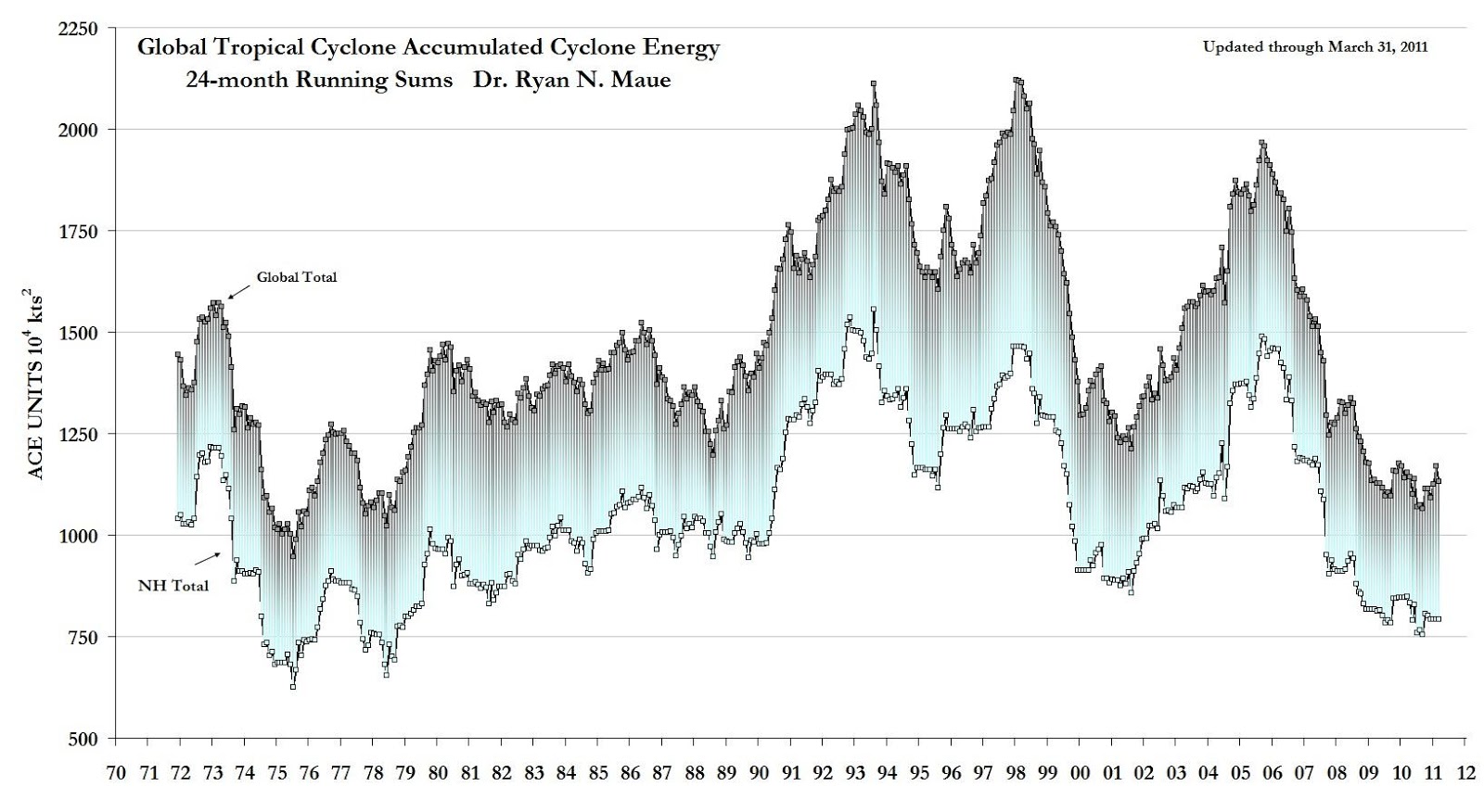
2.  Every measureable attribute of hurricanes -- energy, number of large storms, intensity of storms etc., has been trending downward since the 1990s.  These things go in cycles, with a large random component.  For example here is the accumulated cyclone energy chart:


3.  Most everything in the weather is driven by ocean cycles and the sun.  Atlantic hurricanes tend to follow the Atlantic Meridional Oscillation, which has a 60-70 year periodicity.  (They are also influenced by the El Nino Southern Oscillation, which swaps every year or three, but is currently neutral.)   We are kind of close to an AMO peak right now:


4. Since we are actually seeing LESS hurricanes and WEAKER hurricanes than would normally be expected for the current AMO state, I think Atlantic hurricanes are being moderated by a lack of solar activity which is driving true cooling.  According to Livingston and Penn of the National Solar Observatory in Tucson, the sun may be heading into a deep sleep mode not seen since the Maunder Minimum/Little Ice Age.  This chart shows that sunspots are fading both visually and magnetically independent of the 11-year solar cycle.  We are already losing sunspots:

Chart from solar physicist Dr. Leif Svalgaard

Henrik Svensmark (physicist and professor at the Danish National Space Institute in Copenhagen) believes that solar activity modulates cosmic ray flux causing more clouds to form during times of less solar activity.  The data seem to bear him out:


Global Cooling has already started.  Get ready for the next Little Ice Age!

Thomas Wyke, Frost Fair on the Thames in London, Winter of 1683-1684

.

Monday, October 8, 2012

Falcon-9 Engine Explodes During Launch

.
Yesterday 7 October 2012, the SpaceX Falcon-9 launch vehicle sustained an explosion in one of its nine first-stage engines during launch.  The remaining engines were apparently undamaged and the vehicle was able to continue on to orbit.

The Falcon-9 is designed with Kevlar shields surrounding each engine, so that in the event of an explosion, damage to neighboring engines is mitigated.

The video below shows an apparent hot spot on the engine bell, which gets brighter and brighter prior to the explosion.  Afterwards, you can see portions of the damaged external fairing falling away.

I do not believe that any previous launch vehicle has ever been able to sustain an engine explosion and then carry on with the mission.  The SpaceX system design is surprisingly robust.


Here are some reference photos of the engine configuration:


 .

Sunday, September 30, 2012

EC-ECB-IMF Withholding Economic Data to Help Obama's Reelection

.
I found this article buried deep on Reuters. Excerpts below:
Troika report on Greece may come after U.S. vote
      BRUSSELS, Sept 21 (Reuters) - An EU-IMF report into whether Greece's debt is manageable looks set to be delayed until after Nov. 6 because policymakers want to avoid any shock to the global economy before the U.S. election, EU officials and diplomats say.

     The report by the 'troika' of Greece's foreign lenders -- the European Commission, European Central Bank and International Monetary Fund -- was expected during October, possibly before a meeting of eurozone finance ministers on Oct. 8....
     "The Obama administration doesn't want anything on a macroeconomic scale that is going to rock the global economy before Nov. 6," a senior EU official told Reuters, adding that previous troika reports had also slipped.
...
     "As far as European leaders are concerned, they don't want Romney, so they're probably willing to do anything to help Obama's chances," said the source, an EU official involved in finding solutions to the debt crisis.
 
Obama and Socialist French President Hollande

What this means:
The EC, the ECB and the IMF are attempting to directly affect the US elections.  This is a huge concern in itself.  Why do they care?  Well, Obama constantly bails out their unsustainable socialist economies with billions of US taxpayer dollars, and he is presiding over a wholesale destruction of US power and prestige in the world, making the Europeans stronger in comparison.  Also, they share a philosophy and agenda with Obama for a new socialist world of forced equality.  Obama is not good for the US, but he is great for Europe.

The report on whether Greece's debt is manageable is evidently going to be very negative.  I expect that Greece will require further restructuring,  which will likely force the breakup of the Euro zone in domino fashion over the next couple of years.  This default will have immediate effects on the world economy.  I have always said, ever since the 2008 economic crisis began, that the next crisis would involve sovereign debt (in Alinsky-Cloward-Piven fashion, where the solutions to one crisis engender the next).
And what is next after that?  The world currency crisis.  Socialism only works until you run out of other people's money.  We are now entering that stage.  Next, governments will do everything they can to keep their economies going and avoid default.  And that means rampant inflation -- or more likely stagflation.
You can't break economic laws with impunity.  Eventually you have to pay for all the free Obamaphones. (See below for Obamaphone video.)
Read the whole article at Reuters here

.

Where are the Carriers Now? September 26, 2012 Map of US Naval Forces (Open Source Data)

 .

See main page for the latest update

Here is the 26 September 2012 report on US Aircraft Carrier and Naval Force Deployments from Stratfor:

Click the image for larger version

Click here for a description at Stratfor. While Stratfor is a subscription service, they will provide a free article if you give them your email address.

Note: "The Naval Update Map shows an approximation of the current locations of U.S. Carrier Strike Groups and Amphibious Ready Groups, based on available open-source information. No classified or operationally sensitive information is included in this weekly update."

 I strongly recommend Stratfor as a news source for in-depth analysis of geopolitical events.
.

Sunday, August 19, 2012

Where are the Carriers Now? August 2012 Map of US Naval Forces (Open Source Data)

 .

See main page for the latest update

Here is the 15 August 2012 report on US Aircraft Carrier and Naval Force Deployments from Stratfor:

Click the image for larger version

Click here for a description at Stratfor. While Stratfor is a subscription service, they will provide a free article if you give them your email address.

Note: "The Naval Update Map shows an approximation of the current locations of U.S. Carrier Strike Groups and Amphibious Ready Groups, based on available open-source information. No classified or operationally sensitive information is included in this weekly update."

 I strongly recommend Stratfor as a news source for in-depth analysis of geopolitical events.
.

Monday, March 26, 2012

The US has the Largest Fossil Fuel Reserves in the World

.
In November of 2010, the Congressional Research Service produced a report titled "U.S. Fossil Fuel Resources: Terminology, Reporting, and Summary" which shows that the US has the largest reserves of fossil fuels in the world, on a par with Russia, and dwarfing Saudi Arabia.

These reserves, shown in the table below, include technically recoverable oil, natural gas and coal, all expressed in equivalent barrels of oil based on the energy content.  This only includes easily available resources.

click image to enlarge

These energy resources, along with expected future discoveries, have been calculated to last us 400 years at current usage rates. Plus, the new work being done on methane hydrates could give us twice that amount, or even more.

The US has massive amounts of fossil fuels, ready to be utilized.  So why are we so dependent on the Mideast for our energy?  Well, Democrats in Congress have restricted development of oil, natural gas, and coal resources since the early 1970s, creating what is in effect a false energy shortage in the United States over the last 40 years.

Obama is continuing and expanding the policy, despite his election year rhetoric.  Remember that during his campaign in 2008, he stated, "Under my plan...electricity rates would necessarily skyrocket."  And he has said numerous times that energy prices have to go up so that his alternative energy schemes become more viable.  Wind and solar at best cost 10 times as much as fossil fuels -- and that doesn't count the backup fossil fuel generation required to supply power when the wind doesn't blow and the sun doesn't shine.


Tell me how much the economy and your own personal wealth would have improved if energy prices over the last 40 years had been only a quarter of what they were?  Energy costs drive the prices of everything; food, technology, appliances, even homes would have been cheaper without all the energy restrictions imposed by the Democrats in Congress and the White House.

If there is more wealth in the economy, there is more opportunity for new research --  medical procedures and new drugs, and the development of new ideas in technologies of all sorts.  Such an economic boom would mean that lower tax rates would provide the same revenue, so taxes could be cut, leading to an even larger growth in wealth.

Without the Democrats' restrictions, the countries of the Mideast would not have had a strangle-hold on us -- indeed, our money would not have even flowed into their coffers.  Who knows?  We may have been able to avoid several wars.

It is certainly possible that you would have had twice the personal wealth that you have now.


As Senator James M. Inhofe (R-Okla.), Ranking Member of the Senate Committee on Environment and Public Works says,  "The Obama Administration has made a conscious policy choice to raise energy prices, accomplished in good measure by restricting access to domestic energy supplies. Those supplies are, according to the Congressional Research Service, the largest on Earth. We could help bring affordable energy to consumers, create new jobs, and grow the economy if the Obama Administration would simply get out of the way so America can realize its true energy potential."

We can start the economic boom now, if we vote out of office those who prefer us to be dependent and poor.
.

Saturday, February 11, 2012

Where are the Carriers Now? Weekly Map of US Naval Force Deployments from Available Open Source Information

 .

See main page for the latest update

Here is the 8 February 2012 report on US Aircraft Carrier and Naval Force Deployments from Stratfor:

Click Image for Larger Version and Description at Stratfor

I strongly recommend Stratfor as a news source for in-depth analysis of geopolitical events. They are temporarily offering their services free of charge in the aftermath of a hacker attack on their website last December.
.

Mathematics is the Soul of the Universe

.
Most children learning arithmetic in school -- mostly by rote memorization -- are never even told about the beauty of true, deep mathematics. They graduate and live their lives with no concept that mathematics defines the soul of the universe.

Here are a few hints of the depth that is hidden from most people:
  • The Square Root of Negative One. What number when multiplied by itself equals negative one? Well, there is no such number. And yet, we define that it exists, call it "i", and use this imaginary number to design electronics. There would be no radio, video, phones, or computers without the square root of negative one. I think this makes electrical engineers true wizards.
  • Transforms. If you have a complex mathematical problem to solve, you can often define a new universe with different mathematical rules where it can be solved much more simply. You transform the problem into that universe, solve it, and then transform it back. Does this universe really exist? Well, it works. That's all I know. 
  • Euler's Identity.  If you take "e" and raise it to the product of "i" and "pi", then add 1, the result is zero. This equation has the base of the natural logarithms "e", the square root of negative one "i", the ratio of the circumference to the diameter of a circle "pi" (which shows up virtually everywhere in mathematics and physics), the multiplicative identity "1", the additive identity "0" -- and nothing else.

Stanford University mathematics professor Dr. Keith Devlin has said,
"Like a Shakespearean sonnet that captures the very essence of love, or a painting that brings out the beauty of the human form that is far more than just skin deep, Euler's Equation reaches down into the very depths of existence."
I look at the very deep work currently being done in mathematics, and am chastened by this thought: All of the great mathematicians of the past had no idea that their purely theoretical work would become the basis of vast technological industries. What will tomorrow bring?


.

Ayrton's 1901 Prediction of Cellular Phones

.

In 1901, Professor William Edward Ayrton predicted that people would soon be able to talk one-on-one across the globe, thus describing the basic function of the cell phone, as distinguished from broadcast radio which was then in its infancy.

I am particularly struck by his description of the likely conversation (see below).  A few years ago, I was in the middle of the Yucatan jungle, and received a very similar call from one of my colleagues, who did not know where I was, asking if I was available to attend a meeting.

Here is a summary of Ayrton's statement from "The Century Illustrated Monthly Magazine" of March 1902 :

In commenting on Mr. Marconi's paper (read before the Society of Arts in May) Professor Ayrton said that we were gradually coming within thinkable distance of the realization of a prophecy he had ventured to make four years before, of a time when, if a person wanted to call to a friend he knew not where, he would call in a very loud electromagnetic voice, heard by him who had the electromagnetic ear, silent to him who had it not. "Where are you?" he would say. A small reply would come, " I am at the bottom of a coalmine, or crossing the Andes, or in the middle of the Atlantic." Or, perhaps in spite of all the calling, no reply would come, and the person would then know that his friend was dead. Think of what this would mean, of the calling which goes on every day from room to room of a house, and then think of that calling extending from pole to pole, not a noisy babble, but a call audible to him who wants to hear, and absolutely silent to all others. It would be almost like dreamland and ghostland, not the ghostland cultivated by a heated imagination, but a real communication from a distance based on true physical laws.

From Engineering Magazine (Jul 1901) as described in ‘Marconi and his Transatlantic Signal’, The Century Illustrated Monthly Magazine (March 1902), Vol. 63, p782.

A postscript:  In perusing Vol. 63 of "The Century Illustrated" on Google Books, I am struck by the fact that each edition of this monthly mass-market magazine was hundreds of pages long (monthly books really), and absolutely full of magnificently detailed technical articles (with engineering drawings), poems, works of art, history, humor, first-person accounts, descriptions of foreign lands and experiences, and insight into current events -- an in-depth exploration of the cultural detail of the world at the time.

No publication today even comes close to matching it.  Most modern people don't even know our own language well enough to fully understand this magazine, and they certainly don't understand the cultural and historical references in it that still form the basis of American culture. Yes, we have Ayrton's cell phones now, but most of us don't have any idea of how they work.  Nor would we care to read a magazine explaining them.  They are simply magic placed into the hands of modern barbarians.
.

Tuesday, January 17, 2012

Video of Costa Concordia Saluting the Island of Giglio in August 2011

.

It seems that performing a close approach to the island of Giglio was fairly routine for the Concordia. This video was taken in August 2011.


I went to marinetraffic.com and looked up the AIS records, which show a close approach on 13 Jan 2012, followed by disaster.  The three inflection points in the track shown in the photo and map below are at 20:37 UTC (15.3 knots), 20:53 UTC (2.9 knots), and 21:02 UTC (1.1 kts).  But note that the straight lines between these points do not necessarily show the ships behavior, since marinetraffic.com has no data for those times.


A Turkish web site SeaNews Turkey provides a chart that apparently uses additional AIS data showing a very close approach to a sub-island called Isole del Scole.  Rocks are nearly coincident with the ship track.  In this very likely scenario, the Concordia hit the rocks then traveled across the mouth of the port before stopping.  According to the captain, they then headed closer to shore, purposefully grounding off a small headland (to the left of the end of the red line) to avoid sinking in deep water.


"No emergency call, play down the situation, abandon ship."
"Are you talking about this ship or about Europe?"

.

Wednesday, November 30, 2011

Pakistan, Russia and the Threat to the Afghan War

.
PAKISTAN, RUSSIA AND THE THREAT TO THE AFGHAN WAR
November 29, 2011
By George Friedman

Days after the Pakistanis closed their borders to the passage of fuel and supplies for the NATO-led war effort in Afghanistan, for very different reasons the Russians threatened to close the alternative Russia-controlled Northern Distribution Network (NDN). The dual threats are significant even if they don't materialize. If both routes are cut, supplying Western forces operating in Afghanistan becomes impossible. Simply raising the possibility of cutting supply lines forces NATO and the United States to recalculate their position in Afghanistan.

The possibility of insufficient lines of supply puts NATO's current course in Afghanistan in even more jeopardy. It also could make Western troops more vulnerable by possibly requiring significant alterations to operations in a supply-constrained scenario. While the supply lines in Pakistan most likely will reopen eventually and the NDN likely will remain open, the gap between likely and certain is vast.

This satellite imagery depicts trucks laden with fuel and supplies for the NATO-led campaign in Afghanistan stacked up at the Torkham border crossing in Pakistan near the Khyber Pass during a similar incident in October 2010.
(click image for larger version)

The Pakistani Outpost Attack

The Pakistani decision to close the border crossings at Torkham near the Khyber Pass and Chaman followed a U.S. attack on a Pakistani position inside Pakistan's tribal areas near the Afghan border that killed some two-dozen Pakistani soldiers. The Pakistanis have been increasingly opposed to U.S. operations inside Pakistani territory. This most recent incident took an unprecedented toll, and triggered an extreme response. The precise circumstances of the attack are unclear, with details few, contradictory and disputed. The Pakistanis have insisted it was an unprovoked attack and a violation of their sovereign territory. In response, Islamabad closed the border to NATO; ordered the United States out of Shamsi air base in Balochistan, used by the CIA; and is reviewing military and intelligence cooperation with the United States and NATO.

 (click image for larger version)

The proximate reason for the reaction is obvious; the ultimate reason for the suspension also is relatively simple. The Pakistani government believes NATO, and the United States in particular, will fail to bring the war in Afghanistan to a successful conclusion. It follows that the United States and other NATO countries at some point will withdraw.

Some in Afghanistan have claimed that the United States has been defeated, but that is not the case. The United States may have failed to win the war, but it has not been defeated in the sense of being compelled to leave by superior force. It could remain there indefinitely, particular as the American public is not overly hostile to the war and is not generating substantial pressure to end operations. Nevertheless, if the war cannot be brought to some sort of conclusion, at some point Washington's calculations or public pressure, or both, will shift and the United States and its allies will leave Afghanistan.

Given that eventual outcome, Pakistan must prepare to deal with the consequences. It has no qualms about the Taliban running Afghanistan and it certainly does not intend to continue to prosecute the United States' war against the Taliban once its forces depart. To do so would intensify Taliban attacks on the Pakistani state, and could trigger an even more intense civil war in Pakistan. The Pakistanis have no interest in such an outcome even were the United States to remain in Afghanistan forever. Instead, given that a U.S. victory is implausible and its withdrawal inevitable and that Pakistan's western border is with Afghanistan, Islamabad will have to live with -- and possibly manage -- the consequences of the re-emergence of a Taliban-dominated government.

Under these circumstances, it makes little sense for Pakistan to collaborate excessively with the United States, as this increases Pakistan's domestic dangers and imperils its relationship with the Taliban. Pakistan was prepared to cooperate with the United States and NATO while the United States was in an aggressive and unpredictable phase. The Pakistanis could not risk more aggressive U.S. attacks on Pakistani territory at that point, and feared a U.S.-Indian entente. But the United States, while not leaving Afghanistan, has lost its appetite for a wider war and lacks the resources for one. It is therefore in Pakistan's interest to reduce its collaboration with the United States in preparation for what it sees as the inevitable outcome. This will strengthen Pakistan's relations with the Afghan Taliban and minimize the threat of internal Pakistani conflict.

Despite apologies by U.S. and NATO commanders, the Nov. 26 incident provided the Pakistanis the opportunity -- and in their mind the necessity -- of an exceptional response. The suspension of the supply line without any commitment to reopening it and the closure of the U.S. air base from which unmanned aerial vehicle operations were carried out (though Pakistani airspace reportedly remains open to operations) was useful to Pakistan. It allowed Islamabad to reposition itself as hostile to the United States because of American actions. It also allowed Islamabad to appear less pro-American, a powerful domestic political issue.

Pakistan has closed supply lines as a punitive measure before. Torkham was closed for 10 straight days in October 2010 in response to a U.S. airstrike that killed several Pakistani soldiers, and trucks at the southern Chaman crossing were "administratively delayed," according to the Pakistanis. This time, however, Pakistan is signaling that matters are more serious. Uncertainty over these supply lines is what drove the United States to expend considerable political capital to arrange the alternative NDN.

(click image for larger version)

The NDN Alternative and BMD

This alternative depends on Russia. It transits Russian territory and airspace and much of the former Soviet sphere, stretching as far as the Baltic Sea -- at great additional expense compared to the Pakistani supply route. This alternative is viable, as it would allow sufficient supplies to flow to support NATO operations. Indeed, over recent months it has become the primary line of supply, and reliance upon it is set to expand. At present, 48 percent of NATO supplies still go through Pakistan; 52 percent of NATO supplies come through NDN (non-lethal); 60 percent of all fuel comes through the NDN; and by the end of the year, the objective is for 75 percent of all non-lethal supplies to transit the NDN.

Separating the United States yields a different breakdown: Only 30 percent of U.S. supplies traverse Pakistan; 30 percent of U.S. supplies come in by air (some of it linked to the Karakoram-Torkham route, probably including the bulk of lethal weapons); and 40 percent of U.S. supplies come in from the NDN land route.

Therefore, Dmitri Rogozin's threat that Russia might suspend these supply lines threatens the viability of all Western operations in Afghanistan. Rogozin, the Russian envoy to NATO, has been known to make extreme statements. But when he makes those statements, he makes them with the full knowledge and authorization of the Russian leadership. Though he is used to making statements that the leadership might want to back away from, it is not unusual for him to signal new directions in Russian policy. This means the U.S. and NATO militaries responsible for sustaining operations in Afghanistan cannot afford to dismiss the threat. No matter how small the probability, it places more than 100,000 U.S. and allied troops in a vulnerable position.

For the Russians, the issue is the development and deployment of U.S. ballistic missile defenses in Europe. The Russians oppose the deployment, arguing it represents a threat to the Russian nuclear deterrent and therefore threatens the nuclear balance. This was certainly the reason the Soviets opposed the initial Strategic Defense Initiative in the 1980s. Carrying it forward to the 2010s, however, and the reasoning appears faulty. First, there is no nuclear balance at the moment, as there is no political foundation for nuclear war. Second, the U.S.-European BMD scheme is not designed to stop a massive launch of nuclear missiles such as the Russians could execute, but only the threat posed by a very small number of missiles such as might be launched from Iran. Finally, it is not clear that the system would work very well, though it has certainly proven far more capable than the turn-of-the-century predecessor systems.

Nevertheless, the Russians vehemently opposed the system, threatening to deploy Iskander short-range ballistic missiles and even tactical nuclear weapons in Kaliningrad and other locations in response. The Russian concern is obviously real, but it is difficult to believe it is the nuclear balance they are concerned about. Rather, it is the geopolitical implications of placing BMD infrastructure in Central Europe.


Opposition to a Second Containment

Elements of the weapons, particularly radars and interceptors, are being deployed around the periphery of Russia -- in Poland, Romania, Turkey and Israel. From the Russian point of view, the deployment of radars and other systems is a precursor to the deployment of other military capabilities. They are extremely valuable installations that must be protected. Troops therefore will be deployed along with air defenses, and so on. In other words, the deployment of the BMD infrastructure itself may have no practical impact on the Russians, but the indirect consequences would be to set the stage for more expansive military deployments. The Russians must assume this could entail a return to containment, the principle employed by the United States during the Cold War to limit Soviet power.

The Russians see the inclusion of other military forces at the locations of the interceptor and radar deployment as creating a belt of nations designed to contain Russia. Given the uncertain future of Europe and the increasing relative power of Russia in the region, the United States has an interest in making certain any disruption in Europe doesn't give the Russians opportunities to extend their political influence. While the extent to which American planners chose the sites with the containment of Russia in mind isn't clear, from the Russian point of view the motive doesn't matter. Planning is done based on capability, not intent. Whatever the U.S. intent, the move opens the door for containment if and when U.S. policy planners notice the opportunity.

The Russians have threatened actions for years, and in the past few weeks they have become increasingly vocal on the subject of BMD and on threats. Rogozin obviously was ordered to seize on the vulnerability created by the Pakistani move and introduced the now-indispensible NDN as a point where the Russians could bring pressure, knowing it is the one move the United States cannot tolerate at the moment. Whether they intend to shut down the supply line is questionable. Doing so would cause a huge breach with the United States, and to this point the Russians have been relatively cautious in challenging fundamental U.S. interests. Moreover, the Russians are worried about any instability in Afghanistan that might threaten their sphere of influence in Central Asia. However, the Russians are serious about not permitting a new containment line to be created, and therefore may be shifting their own calculations.

It is a rule of war that secure strategic supply lines are the basis of warfare. If you cannot be certain of supplying your troops, it is necessary to redeploy to more favorable positions. The loss of supply lines at some point creates a vulnerability that in military history leads to the annihilation of forces. It is something that can be risked when major strategic interests require it, but it is a dangerous maneuver. The Russians are raising the possibility that U.S. forces could be isolated in Afghanistan. Supply lines into the landlocked country never have been under U.S. or NATO control. All supplies must come in through third countries (less than a third of American supplies come by air, and those mostly through Russian airspace), and their willingness to permit transit is the foundation of U.S. strategy.

The United States and NATO have been exposed as waging a war that depended on the willingness of first Pakistan and now increasingly Russia to permit the movement of supplies through their respective territories. Were they both to suspend that privilege, the United States would face the choice of going to war to seize supply lines -- something well beyond U.S. conventional capacity at this time -- or to concede the war. Anytime a force depends on the cooperation of parties not under its control to sustain its force, it is in danger.

The issue is not whether the threats are carried out. The issue is whether the strategic interest the United States has in Afghanistan justifies the risk that the Russians may not be bluffing and the Pakistanis will become even less reliable in allowing passage. In the event of strategic necessity, such risks can be taken. But the lower the strategic necessity, the less risk is tolerable. This does not change the strategic reality in Afghanistan. It simply makes that reality much clearer and the threats to that reality more serious. Washington, of course, hopes the Pakistanis will reconsider and that the Russians are simply blowing off steam. Hope, however, is not a strategy.

Copyright 2011 STRATFOR. Republished on The Big Dustup with permission, www.stratfor.com.

.

Sunday, November 13, 2011

Tuesday, September 27, 2011

German Chancellor Angela Merkel Creeps Me Out

.
Why is it that German Chancellor Angela Merkel looks so much like another well known German Chancellor from about 70 years ago?  In her posture, her gestures, and even sometimes in her facial expressions, the resemblance is a little creepy.


.

Friday, September 16, 2011

Wind Energy Creates More Jobs - but is that a good thing?

.

The Department of Energy says that wind energy creates jobs.  In fact,
"Wind energy projects generate more new jobs than conventional fossil fuel projects. According to a study by the New York State Energy Research and Development Authority, wind energy produces 27% more jobs per kilowatt-hour than coal plants and 66% more jobs than natural gas plants."

But all that means is that wind energy is totally inefficient and costly.

I wonder if anyone has pointed out to the DOE that hiring people to turn hand-crank generators would create even more jobs per kilowatt-hour.  Hand-cranked energy is the route to full employment for all Americans!

How many hand-cranking Americans does it take to run an electric arc furnace to make steel? I'll bet it would take the entire population of the state of Michigan to generate enough electricity to satisfy the need for steel in Detroit.

Oh wait.  I don't think they need steel in Detroit anymore.


.