On Sunday, 15 May 2011, the Tokyo Electric Power Company (TEPCO) announced that during the initial incident on 11 March, the core of Fukushima No. 1 reactor reached 2800 degrees Celsius, and completely melted down falling into the bottom of the reactor pressure vessel (RPV), forming a large pool of liquid uranium and other substances there. The molten fuel (aka "corium") caused holes or cracks to form in the RPV resulting in a loss of pressure and leakage of water into the secondary containment. This containment is apparently also cracked or punctured, since the 8 tons of water per hour they are currently injecting are showing up in the reactor basement. They plan to up the injection to 10 tons per hour to try to keep the fuel cooler so that it will not keep destroying the concrete and progressing down toward bedrock (china syndrome). Unfortunately, the bedrock is "mudstone", a mixture of loose shales, sand, and ground water, which will not provide a barrier to further dispersion of the corium into the aquifer.
I wonder when will will hear about the condition of Fukushima Nos. 2 and 3. I suspect they are just as bad.
"The President does not have power under the Constitution to unilaterally authorize a military attack in a situation that does not involve stopping an actual or imminent threat to the nation. In instances of self-defense, the President would be within his constitutional authority to act before advising Congress or seeking its consent."
Gary Schmidt, a regional sales manager from Putzmeister America, watches as one of the world's largest concrete boom pumps is loaded onto a Russian Antonov An-124 cargo jet at the Los Angeles International Airport Friday April 8,2011. The Russian cargo planes will carry the massive pumps from airports in Atlanta and Los Angeles to Japan to spray cooling water on reactors at the damaged Fukushima Dai-ichi nuclear plant.
Company personnel walk around a 95-ton Putzmeister concrete pumper to be delivered to Japan at Hartsfield Jackson Atlanta International Airport on April 8, 2011, in Atlanta, Georgia. A Russian cargo plane will transport the 95-ton concrete pumper to assist in the cooling down efforts of the Fukushima Daiichi nuclear power plant.
“High dwellings are the peace and harmony of our descendants,” the stone slab reads. “Remember the calamity of the great tsunamis. Do not build any homes below this point.”
It was advice the dozen or so households of Aneyoshi heeded, and their homes emerged unscathed from a disaster that flattened low-lying communities elsewhere and killed thousands along Japan’s northeastern shore.
Hundreds of such markers dot the coastline, some more than 600 years old.
NHK World offered this rather inadequate diagram tonight (Friday afternoon in Japan) showing the path of the water leaking into the pit at Fukushima Daiichi. Apparently TEPCO has plugged the leak with "liquid glass", whatever that is.
Unsaid is where exactly the exceptionally radioactive water is coming from, and how plugging what is essentially an artesian water source (coming out of the ground), at the final point where it bubbles out, actually solves the problem. I would assume that the ground around the plant is fully saturated with perhaps millions of gallons of radioactive water, which is making its way underground alongside any cable, conduit, tunnel, or pipe toward the sea. I am also concerned about erosion of foundations and footings.
Here is a worker pointing to the pit that the water is leaking into:
Here is the inside of the pit:
Here is the leak before attempts were made to plug it:
Here is the first attempt to plug it. They simply dumped a load of concrete into the pit. It didn't work. The leak just washed away the concrete from the area of the crack. Imagine my surprise.
Now that they have plugged the leak with liquid glass, I would suspect more leaks to pop up in other places.
Reminds me of this old cartoon, where Popeye and Olive Oyl have some trouble with water pipes:
The Japanese were using old newspapers and sawdust in an attempt to stop the leak. Maybe a can of spinach would help.
The New York Times reported today on a March 26th Nuclear Regulatory Commission assessment of the problems at the Fukushima Daiichi nuclear power plant. New information includes:
Filling the containment structures with thousands of tons of water makes them vulnerable to rupture during aftershocks -- especially since their integrity is already questionable after the main quake and the ensuing hydrogen explosions. After the cooling systems failed and the normal cooling pipes either melted or plugged up, the Japanese simply pumped in sea water to immerse the reactor vessel.
"The assessment provides graphic new detail on the conditions of the damaged cores in reactors 1, 2 and 3. Because slumping fuel and salt from seawater that had been used as a coolant is probably blocking circulation pathways, the water flow in No. 1 'is severely restricted and likely blocked.' Inside the core itself, 'there is likely no water level,' the assessment says, adding that as a result, 'it is difficult to determine how much cooling is getting to the fuel.' Similar problems exist in No. 2 and No. 3, although the blockage is probably less severe, the assessment says."
The reactors need to be cooled for many months before they will be able to be decommissioned. Without the closed-loop cooling capability (which has perhaps been lost forever because of the melting of the cores), this must be done by flooding the units with water. But that solution has a large number of problems associated with it, including ground water contamination, storage of the water (or discharge to the ocean), erosion of footings and foundations, etc.
Fragments of radioactive fuel may have been expelled up to a mile away by the hydrogen explosions. A large amount of fuel landed between two reactor buildings, and had to be bulldozed over, presumably to enable workers to be in the area.
It appears that exceptionally radioactive water is escaping from the No. 2 reactor, probably from the toroidal suppression pool that sustained an explosion early in the crisis. This is the water that was flowing from under the ground, through a crack in a concrete-lined pit, and then into the ocean. It has been measured at 7.5 million times the legal limit for ocean dumping. That high of a level would imply that the water is coming directly from the core. Containment has failed.
I also noticed that the measurements of radioactivity at the plant are being hampered by the fact that their rate dosimeters cannot measure greater than 1000 millisieverts per hour (100 rem/hour)-- and the levels are apparently well above that. At 1000 millisieverts per hour, you would have an increased cancer risk in 6 minutes, and would have full radiation sickness symptoms with an hour of exposure. If you stay four hours in that environment, you would likely die from radiation sickness. If you stayed six hours, you would almost certainly die.
.
I sent the following email to a friend of mine last night as a possible explanation for the high radioactivity of the Reactor 3 turbine room water:
The news coming out of Japan is still very meager. After the explosion of reactor building 2, two workers were said to be missing. Were they found? Are they dead? Who knows? The Japanese media is too polite to ask.
Two workers were in a turbine room today with 12 inches of standing water on the floor. They only had on regular boots, which were soaked. After several hours, they developed large sores through to the muscle. Supposedly the radiation levels were measuring fairly low, but most radiation detectors do not detect beta particles because they can be stopped by a sheet of paper.
And indeed, the wounds have been said to be beta burns. What puts out beta? Tritium. But what produces tritium in a nuclear plant that runs with regular water? Well some tritium is produced by neutron bombardment of the water in the reactor, but it is supposed to be a small amount. A hydrogen atom has to pick up two neutrons, which doesn’t happen often. Tritium production is slow even in heavy water reactors.
But Boron, when hit with a high energy neutron, will produce quite a bit of tritium. (When hit with a low energy neutron, it generally goes to lithium.) This would imply that the boron-treated water that they have been putting into the pools and reactors has been boiling away, leaving encrustations of boron behind (and literally tons salt from the sea water, but that is another story). The water, which would act as a neutron moderator, is gone, so the high energy neutrons are converting the boron to tritium.
I bet they are releasing gobs and gobs of tritium, and don’t even know it, since many of their detectors won't see it.
There are two possibilities: 1) The water is coming directly from the core through a breach. 2) The spent fuel pool has become critical and is producing high energy neutrons like a reactor.
.
The Austrian "Zentralanstalt für Meteorologie und Geodynamik (ZAMG) (the official meteorological and geophysical service of Austria), has produced an analysis estimating the total emissions of Iodine-131 and Cesium-137 since the beginning of the crisis at Fukushima Daiichi, finding them of the same order of magnitude as the emissions at Chernobyl. The radiation load is measured in Becquerels (Bq). Each Bq is the disintegration of a single atomic nucleus, so the values become quite large. They are expressed in scientific notation.
"In the phase of March 12 to 13, the Fukushima emissions were mostly transported to the Pacific, eventually hitting the CTBTO station in Sacramento/California. In the phase March 14 to 15, on the other hand, most of the emissions were transported inland, hitting the CTBTO station in Takasaki, Japan. Based on simulated dilution factors and measurements, we were able to have a first rough source estimate.
"Regarding Iodine-131, the picture is relatively homogeneous. A source term [total release] of 1017 Bq per day would explain the measurements in Takasaki as well as Sacramento. The total 4-day emission of 4x10¹⁷ Bq is on the order of 20% of the total emissions of Iodine-131 that occurred during the Chernobyl accident. Regarding Cesium-137, the situation is a bit different. In the cloud eventually propagating to the United States, the ratio of Iodine-131 to Cesium-137 was about 30. This is similar to the Chernobyl accident. In Takasaki, however, this ratio was four. This would indicate a much larger Cesium-137 release in the second two-day period after the accident. Taking this together, the source term [total release] would be about 3x10¹⁵ Bq during the first two days, and 3x10¹⁶ during the second two-day period. In sum, this could amount to about 50% of the Chernobyl source term of Cesium-137.
So far, I believe Japan has been very lucky that the winds have been primarily out to sea (toward the east). I also note that their evacuation/shelter zone is the exact same size as the one that was initially specified for Chernobyl: 30 km (approx. 19 miles). However, the American government has advised their citizens to evacuate out to 50 miles from the plant. The outskirts of Tokyo are only 130 miles away, with fairly large population centers in the 100 mile range.
It is important to note that the total quantity of fuel involved in the Fukushima Daiichi disaster is much more than that at Chernobyl -- perhaps by a factor of 30 times. There are at least 3 fueled reactors with very serious damage, and an exceptionally large amount of fuel was being stored in each of the spent fuel pools. Plus some concern exists about the fifth and sixth reactors and pools.
This is still an exceptionally serious situation. .
Reactor Building 3 at the Fukushima Daiichi Nuclear Power Plant has sustained significant damage from a hydrogen explosion that was much larger than the explosions that damaged the other buildings. The question that we would like to answer is whether or not the top of the reactor vessel or any of the various levels of containment have been damaged, and whether or not the spent fuel pool has been damaged.
First, we need to understand the configuration of the spent fuel pool and the top of the reactor. Here is the schematic of the power plant:
During refueling or inspection, the top cap of the concrete shell, the steel containment vessel, and the top of the reactor vessel can be removed by the building crane to access the fuel rods in the reactor. Before this operation, the spent fuel pool and the top of the reactor area are all flooded with water. This enables the fuel to be removed and placed into the spent fuel pool while still being submerged at all times. The way the design allows this to be done can be seen more easily in the next figures.
The whole top area is flooded when transferring fuel. Seals around the reactor keep the water from flowing into the dry well. Gates with inflatable seals keep the water in the spent fuel pool after the operation is complete. Except for the gates, the fuel pool is surrounded by fairly thick concrete.
The source of these diagrams is at "All Things Nuclear": http://allthingsnuclear.org/post/3964225685/possible-source-of-leaks-at-spent-fuel-pools-at They also have a more detailed discussion about seal integrity, and the fact that leakage has occurred in other plants when the air pressure is lost and the seals deflate. It is likely that the seals are at least leaking, or may even be blown away completely in some cases.
The following is an overhead view (also from the previous link) "of an irradiated spent fuel bundle being transferred from the reactor core (lower right) to the spent fuel pool (upper left) through what is called the 'cattle chute' at the Browns Ferry Nuclear Plant in Alabama. The spent fuel pool gate has been removed to connect the spent fuel pool water with the water in the reactor well area above the open reactor pressure vessel."
To further understand what this looks like at Fukushima, we can peer into the ruins of Reactor Building 4:
We are looking here at the SE corner of the building. I am fairly sure that the top two "stories" of number 4 are the open area at the top of the reactor where the crane runs. The floor of the second floor from the top, where the steam is coming from, is the top of the spent fuel pool. In the following closeup, you can see the green building crane dolly, about the size of a Greyhound bus, which appears to have fallen from its rails and is laying on top of the spent fuel pool. The thick and largely intact gray beam above the crane is one of the rails, I believe.
For number 4, the spent fuel pool may be intact, but the holes in the building on the right side, third floor from the top make me wonder. Also, the gates with their inflatable seals, are probably leaking badly. The Japanese apparently have been successful in spraying large quantities of water into this area.
In looking at the photos of the Reactor Building 3 damage, my concern is that the top of the remaining ruins are so low that the reactor top may be missing, and the spent fuel pool largely destroyed.
First let's look at the Number 1 building for some perspective on the problem. A hydrogen explosion destroyed the top crane attic of this building too, but much less damage to the rest of the building occurred. It appears that Number 1 had a different design, with a more fragile upper two stories. This weakness allowed the explosion (which may have been smaller to begin with) to exit the building without building up damaging pressure in the lower floors. The remaining top structure beams are the equivalent height as the top two stories in Buildings 3 and 4, I believe, even though the top of Number 1 has three repeating structures, i.e. three "stories".
We do not see all the way to the ground around the building, but it appears that the top one-quarter is damaged. It also appears that a central structure exists -- perhaps the top cover to the reactor, perhaps not. I would expect that the top of the spent fuel pool is right at the top of the undamaged section.
Reactor Building 3 sustained severe damage from a very large explosion. The damage to the facing side of Number 4 was caused by the explosion of Number 3. In the following video, note the large structural components falling after being blown thousands of feet into the air.
Here are views of the damage to 3:
Reactor Building 3 in foreground left. North side of Reactor Building 4 in middle of image.
The west side of 3
The northeast corner of 3 (left upper part of the frame), looking mostly east
The southeast corner of 3
Looking down onto the west side of 3
The northwest corner of 3. West side of 2 on left, north side of 4 on right. Intervening materials and structures do not allow us to see the base of the buildings, making the buildings seem shorter than they are.
West side of 3. The damage on this side is extensive down to a level below that seen on the east side. The building is basically destroyed to the tops of the support buildings nearby.
I believe that the top of the free standing skeleton wall on the east side is at the original top of the building. The spent fuel pool at the SE corner, with the steam coming out, appears to have some damage to its concrete walls and structure, but may be largely intact. I would suspect that the gates and seals are gone -- blown away by the explosion. This would mean, based on the diagrams above, that the tops of the rod assemblies in the pool are at the top of the maximum possible water level with no gates. It is likely impossible to fully cover the rods.
There is no evidence of the building crane dolly. Not sure where it went.
The following thermal IR image shows the spent fuel pool in 3 glowing at 62 deg C. The center of the building, around the reactor cap, is glowing at 128 deg C. This likely represents steam leaking from the primary containment through a damaged reactor dry well top cap -- or perhaps scattered fuel assemblies.
The spent fuel pools were pretty much at or above capacity. Those in Building 3 contained MOX, a mixture of plutonium and uranium. Not good. Probably worse than is being reported, if my analysis is correct.
And I am really concerned about what is happening under that hot roof of Building 2.
Japanese NHK TV showed these images today (22 March in Japan). Some areas are supposedly 128 degrees C. They also mentioned a core temperature, but I must have heard it wrong. I thought I heard 300-some degrees C. Can't be right. Black smoke has been coming out of reactor 3.
NHK TV image
Fukushima Reactors 1 through 4 in false-color IR. Blue and green are cool, orange and red are hot, white is very hot
Closeup of Reactor 3
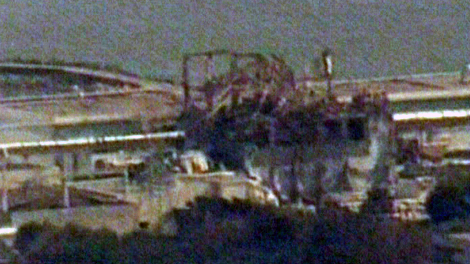
Reactor 3. The building appears to have been almost totally destroyed. I can't imagine that the spent fuel pool is intact. It is located fairly high in the structure -- and there is nothing left much higher than the surrounding low buildings. I wonder if the reactor vessel top has been crushed or broken off.
"Amid concerns of wider contamination, a nuclear safety official said the government was caught off-guard by the accident's severity and only belatedly realized the need to give potassium iodide to those living within 12 miles (20 kilometers) of the Fukushima Dai-ichi nuclear complex.
"The pills help reduce the chances of thyroid cancer, one of the diseases that may develop from radiation exposure. The official, Kazuma Yokota, said an explosion at the plant's Unit 3 reactor last Sunday should have triggered the distribution. But the order only came three days later.
"'We should have made this decision and announced it sooner,' Yokota told reporters at the emergency command center in the city of Fukushima. "'t is true that we had not foreseen a disaster of these proportions. We had not practiced or trained for something this bad. We must admit that we were not fully prepared.'"
Radioactive iodine beyond Japan's regulated standard was detected in tap water in a town in Fukushima Prefecture on Thursday, apparently due to the nuclear crisis at the Fukushima Daiichi nuclear power plant, the government said Saturday.
The health ministry said levels on Friday and Saturday in the town of Kawamata were below the limit but milk there has been found to contain radioactive iodine above the country's standard, raising concern about radioactive contamination in the region.
Kawamata is located around 45 kilometers northwest of the nuclear power plant.
Meanwhile, slight amounts of radioactive iodine have been detected in tap water in Tokyo, its vicinity and most prefectures neighboring Fukushima, the government said the same day.
While the substance was found in Tochigi, Gunma, Niigata, Chiba and Saitama prefectures as well as Tokyo, traces of cesium have been also found in tap water in Tochigi and Gunma, the Ministry of Education, Culture, Sports, Science and Technology said, adding the levels would not affect human health even if ingested.
Tochigi, Gunma and Niigata prefectures border Fukushima Prefecture.
The Gunma prefectural government said it had detected the substances for the first time since it began testing tap water for radioactive materials in 1990.
.
The Swedish government, as reported on the government Radiation Protection Agency website, is advising all Swedes in the Tokyo area to begin taking potassium iodine tablets based on an expected wind change that will bring radiation into the city.
Any Swedes who do not have tablets can pick them up at the Swedish Embassy in Tokyo.
The radiation released in Japan is fairly small compared to, say, Chernobyl, and should not cause much of a concern for the US. But the whole situation has raised awareness of nuclear radiation and the potential for future nuclear disasters.
Since the mid-1990s, I have maintained a personal stock of potassium iodate medication, which protects the thyroid from radioactive iodine-131. I chose potassium iodate (KIO3) (from a company called Medical Corps) because of its longer storage life when compared with potassium iodide (KI). Additionally, some studies show that large doses of KI may cause thyroid cancer.
Either medication is only to be taken in an acute emergency, and certainly is not recommended for general everyday use or for low levels of radiation such as what we expect to see wafting in from Japan.
But radioactive iodine-131 is only one part of the problem, and I have been wondering what to do about the other radioactive elements that are produced in nuclear disasters of various sorts. The most concerning products of nuclear fission in addition to iodine-131 are strontium-90, cesium-137, and cesium-134. You would see these in any nuclear plant meltdown or following a nuclear explosion. But in a "dirty bomb" situation, all bets are off, and you could see just about any radioactive element from radium to cobalt-60 to polonium.
Noodling around on the web, I found all kinds of information and disinformation, including so-called holistic cures of very dubious efficacy.
Then I stumbled onto the US Department of Health and Human Services' excellent web site called "Radiation Emergency Medical Management - Guidance on Diagnosis and Treatment for Health Care Providers", located here. You can download the whole site as a zip file (569 MB) to your computer here, or an abridged version onto your mobile device here. I would suggest that everyone download the whole site. On the internet, you never know when something may disappear.
The site is vast, and includes information on every medical aspect of radiation contamination with full descriptions of what to do in almost any eventuality. One page shows a table of radioactive isotopes and their effects on the body, along with another table listing the various countermeasure medications to be used for each isotope. Unfortunately, several of these medications are prescription only, which means of course that in a real disaster, by the time the medications get to people, it will likely be too late.
But to protect against strontium-90 and cesium-137/134, it might be a good idea to get some Prussian Blue, and some sodium alginate (made from kelp), both of which appear to be readily available (although the medical-grade Prussian Blue, aka Radiogardase, is apparently prescription only).
Medical Corps is currently trying to get caught up on their orders for KIO3, and has suspended new orders temporarily, but they apparently still have a very large stock.
Of course, keeping radioactive isotopes out of your body as much as possible to begin with is the best thing to do. Contamination on the skin can be washed off, but the effects get much worse when radioactive particles are ingested or inhaled. The first line of defense is a good mask. Even now, you can pick up surplus nuclear/biological/chemical masks, with a bunch of extra filters, for less than $50 on eBay.
Cold War era radiation survey meters (geiger counters and the like) are also available on eBay, but are not very sensitive. A good modern alternative is The Inspector, for about $500. These all measure dose rate -- how much radiation you are exposed to per hour. Cold War era pen-shaped dosimeters are also available that measure your accumulated dose. Again, they are not very sensitive and are more suited to a nuclear war situation, where you are trying to determine if you will be 1) not sick, 2) a little sick, 3) not going to make it.
In other words, most of the Cold War items are intended mostly for triage and deciding when you might be able to leave a shelter, not for trying to determine if you are getting a small dose that may increase your cancer risk.
JP Laboratories makes some postage stamp-sized RADsticker dosimeters that are cheap ($4), but only start to change color at 25 rads. A friend gave me one, but I really want to know well before I get that much radiation.
They also have the credit card-sized RADTriage-FIT that starts to change color at 1 or 2 rads, which is probably about right since the allowed yearly occupational dose is 5 rads, and it is generally accepted that cancer risk begins to increase around 10-20 rads. These dosimeters have limited life (a year or two), but can be frozen to increase life to 5 years or so. A good site for some of these items is KI4U, Inc.
Click on the image below for a high resolution version. Be sure to click a second time if your browser defaults to a version that autofits to your window.
I would suggest that the cessation of steam coming from the reactors is concerning. There may be no water in them anymore.
.
Here is a partial plot of radiation rates at the main gate and other locations around the nuclear plant at Fukushima Daiichi.
Click image for larger version
The peaks at 12,000 microsieverts/hour corresponds to 1.2 rem per hour. Less than two hour's exposure at this rate would be equivalent to the maximum occupational exposure limit for an entire year (2 rem). A day's exposure would be quite unhealthy. Several days could cause acute radiation sickness.
(The occupational exposure limit for emergencies is 10 rem. This has been increased to 25 rem for Fukushima. After workers reach this limit, they cannot return to the plant.)
Note that these peaks were measured at the main gate -- a long way from the reactors themselves.
CNN is reporting tonight that a radiation exposure rate of 20,000 microsieverts/hour has now been recorded. The highest peak so far. Things don't seem to be getting better.
.
The website of the Japan Atomic Industrial Forum (JAIF) has the latest detailed status of the damage and the efforts being taken to regain control of the situation. Here is their website: http://www.jaif.or.jp/english/index.php
The latest report is dated 18 March, 1000 JST (17 March 2100 United States EDT) and is shown below:
Click image for larger version
The complete pdf report from the JAIF website also contains additional information




 .


